Loading...

One of the numerous events at Seawork this year is the hand-over of an aluminium fishing patrol boat North Eastern Guardian IV, a fisheries patrol vessel that was built in the very port she will operate from.
The boat was built after Parkol, the northeast English shipbuilder, won an international tender from the North Eastern Inshore Fisheries and Conservation Authority (NEIFCA) for a survey and patrol vessel.
The boat, which will replace the North Eastern Guardian III, was handed over on Wednesday by Parkol commercial director Sally Atkinson to David McCandless, Chief Officer for IFCA.
“On behalf of our organisation it’s a real pleasure to accept this vessel,” McCandless said. “It’s a cracking vessel and we’re looking forward to making good use of it to protect marine fisheries off the Yorkshire coast, and it will serve us for a 20-year period. It’s a fantastic asset.”
“From a small boatyard in North Yorkshire, one of the most important things to me is that we continue to build these vessels in the local area to carry on that tradition,” said Sally Atkinson. “This project also demonstrates that while historically it’s always been fishing vessels, and this is the first time we’ve built a vessel like this, an aluminium catamaran. It shows that there are skills in the UK that are transferrable from one type of shipbuilding to another."
North Eastern Guardian IV was built with the help of naval architects Chartwell Marine, who designed the Ambitious Class Crew Transfer Vessel hull and helped to adapt it in various ways – for example adding a keel, and thicker aluminium plates.
“The cool thing about this is that Parkol won this tender internationally – the Northeast Inshore Conservation Authority (NEIFCA) went to Thailand, Singapore, Turkey and various European and UK shipyards and their weighting in the tender was 60/40 quality over price,” said naval architect Andy Page, Chartwell Marine MD.
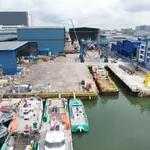
“They decided to focus on quality and socio-economic values of building locally over taking the easier capital purchase decision of building overseas where it might be cheaper. They are building it in the port of Whitby, where the vessel will be operating, and what a bold decision to make, to build it locally.
“This is the first aluminium vessel the shipyard has built – they’ve built a huge number of amazing steel craft, but this has opened the door to aluminium construction in Whitby and Middlesbrough, which have a fantastic shipbuilding history but have struggled in recent times to build new things where we used to build so much.”
“From Parkol’s perspective we ordinarily we wouldn’t have looked at this tender because we didn’t have a track record in aluminium catamarans – we’d never built one before,” said Atkinson. “But because it was a local customer, we decided we would give it a go. And there are a number of firsts for us – it was the first public tender we’d bid on, and we won it; the first catarmaran, the first aluminium structure, the first time we’d worked with Chartwell.”
Some of the vessel’s key features include:
Length: 24.5 metres
Beam overall: 8.87 metres
Height: 8.23 metres.
Top speed of 20kn
IMO Tier III compliant
27 tonnes of cargo capacity, including RIB for high-speed patrols
Dedicated onboard wet lab
High-tech acoustic equipment for ultra-accurate 3D imaging
“It’s a huge feather in the cap for our region’s fisheries that, following a hugely competitive international tender process, this vessel is going to be built in our home port, by a local company with such a long and respected shipbuilding heritage as Parkol,” said McCandless.
“When completed, it will be a frontrunner for the whole country, demonstrating what can be achieved in the battle to preserve our precious sea environments. We’re hugely excited about watching the boat take shape over the next year-and-a-half, and then seeing the difference it can make.”
Exhibitors; Parkol Marine Engineering Chartwell Marine