Chartwell Marine has announced that its electric foiling high-speed trimaran demonstrator has entered build.
The ‘TriFoiler’ demonstrator, now in build at Designcraft Ltd, Southampton-based specialists in composite vessel construction, will provide ‘real world’ proof of concept for a simpler and more cost-effective foiling ferry design, capable of zero-emissions, high-speed operation. The vessel is set to be operational by March 2025.
The £1.86 million project, funded by Innovate UK, is a partnership between Chartwell Marine, Solent University and Newcastle Marine Services to develop and build the scaled demonstrator with the end goal of supporting the decarbonisation of short coastal journeys, which often run relatively empty during quieter periods of the day, while reducing operational costs for ferry operators.
“Foiling technology has great potential to significantly increase the range and viability of electric vessels, specifically in the passenger ferry industry, where routes, operations, and conditions are predictable and typically consistent,” said Andy Page, Managing Director, Chartwell Marine.
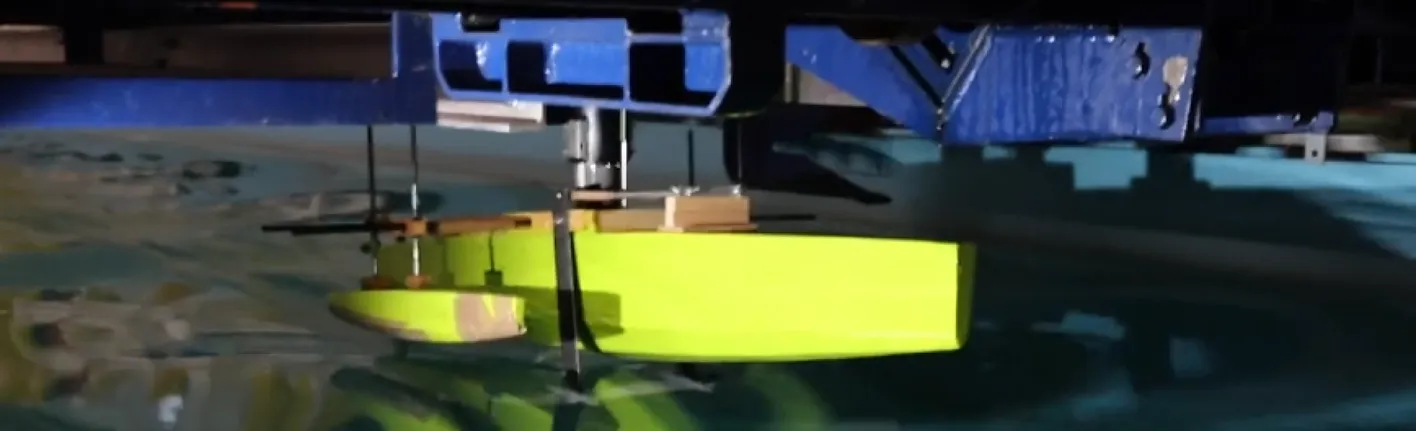
The 10-metre demonstrator will feature a single fixed main foil, with the foiling and flight control carried out by a single foiling rudder. The design enables the TriFoiler to foil with less power than either a monohull or catamaran-based design, offering commercial ferry operators a cost-effective option for building and operating the vessel.
Capable of reaching 18 knots, the demonstrator vessel will be powered by twin 20kW motors with 60kWh battery capacity and can accommodate three people. A unique feature of the trimaran is that the batteries are positioned out wide on the craft, away from the passenger and crew area to enhance safety and maximise useable space.
Prior to the TriFoiler hitting the waters in early 2025, a full-sized digital twin is scheduled to undergo testing at the Solent University simulator to assess its handling, stability, and efficiency across various simulated environments.
Once the demonstrator has been successfully deployed, the plan is to develop a commercial-scale vessel, based on the learnings gained from this project. Chartwell expects the final vessel to be a 24-metre craft, capable of reaching 26-28 knots, with a capacity of up to 40 passengers. With approximately 300kW of installed power, the vessel will be highly efficient, and buildable at low cost.
Watch the video to see how the team has approached the project and the plans for the future;