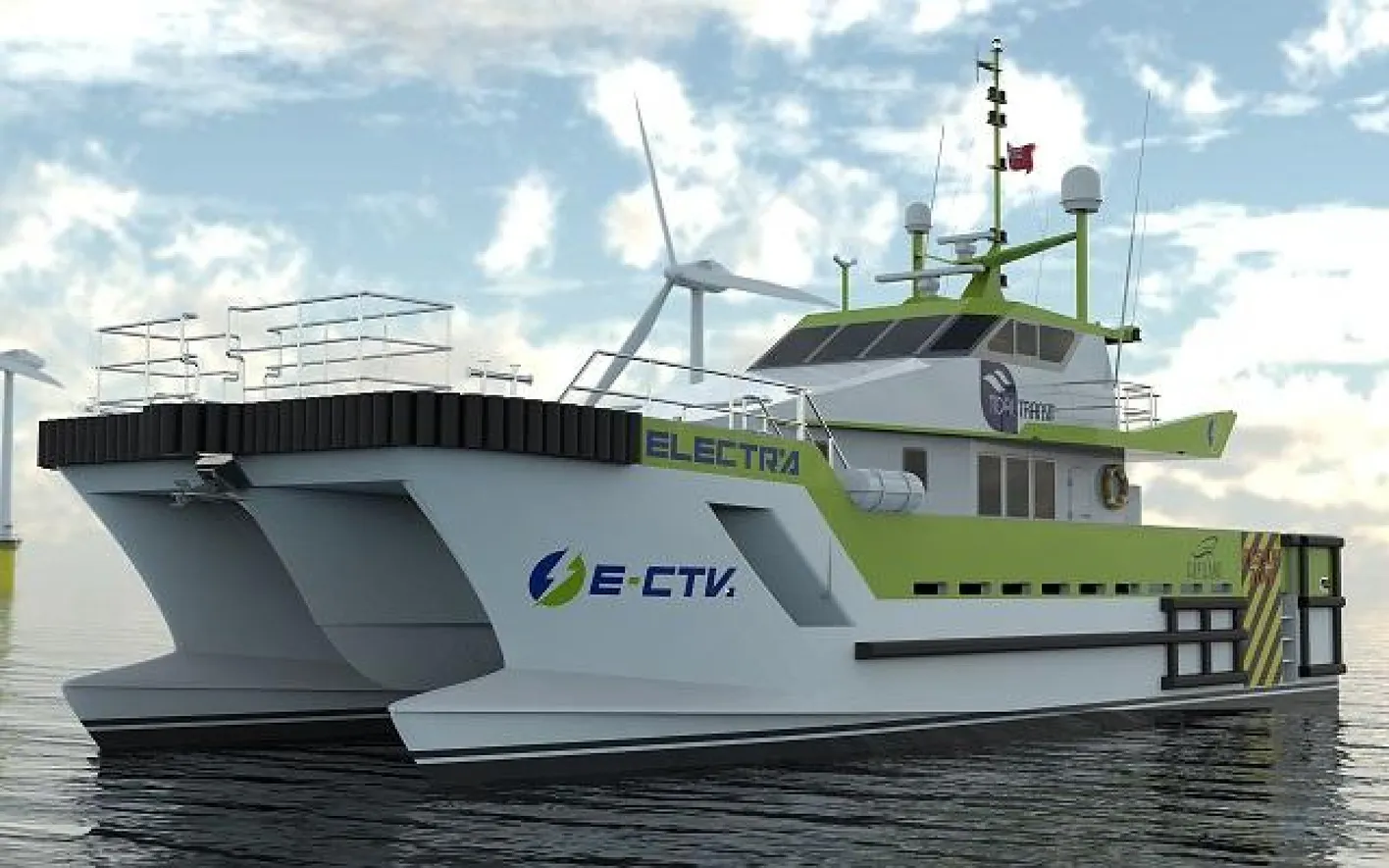
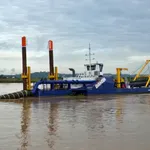
A Crew Transfer Vessel’s diesel engines will be replaced with a zero-emissions Volvo Penta solution to create the world’s first retrofitted Electric Crew Transfer Vessel (E-CTV). Using an existing vessel delivers better circularity and sustainability and helped make the project one of just 10 leading-edge developments awarded UK government funding as part of an industry-led transition to net-zero.
Retrofitting will be done on Ginny Louise, a 20m, diesel-powered Mercurio vessel. The old propulsion system will be replaced with a Quad Installation of Volvo Penta IPS 30 paired with fully electric motors and over 2 MW of on-board battery capacity. The completed vessel will be re-named e-Ginny and as well as being emissions-free will also benefit from a host of additional benefits that IPS delivers. This includes seamless movement and control, courtesy of the forward-facing, individually steerable drives with twin counter-rotating propellers.
“We are delighted to be involved with such a landmark project, which will feature our first ever Volvo Penta IPS powered 100% by batteries and with no on-board diesel generators. It’s an ultra-efficient set-up that will deliver longer-range and emissions-free transfers. There’s also closer control and manoeuvrability so journeys are safer, faster and more reliable. We believe this is the future for a number of segments within the marine industry and hope it will inspire further projects,” said Mehmet Belibagli, Sales Manager, Marine Commercial at Volvo Penta UK.
The vessel is being developed for sea transport and crew transit service operator Tidal Transit. Cost of the retrofit is estimated at £8 million (€9.4 million) with £6.3 million (€7.4 million) coming from the Zero Emissions Vessel and Infrastructure (ZEVI) program. The program is part of the UK Government's plan (via its Department of Transport and Innovate UK innovation agency) to develop, deploy and operate clean maritime solutions.