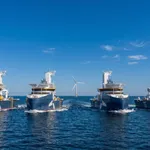
The next evolution of Volvo Penta’s almost iconic IPS Professional Platform was taken for a spin off the east coast of England last week, with Seawork’s Isabelle Bylett at the controls. On an hour-long sea trial, the 38m former Norwegian passenger ferry Penta 40 was taken through her paces to demonstrate how the platform integrates propulsion, electronic controls and power management, and now extends the IPS system, introduced in 2005, to larger commercial vessels and superyachts.
Making manoeuvring more manageable
During docking at Great Yarmouth, the vessel’s bow remained steady despite low tide and a strong current. Joystick controls enabled small, measured adjustments. Kajsa Mentes, senior test engineer, said the aim was “to make stressful situations feel calm”. Assisted docking could help in confined spaces or single-handed operations, allowing an operator to bring the vessel alongside before handling lines and fenders. Visitors tried the controls, which felt intuitive even to a novice. IPS directs thrust through forward-facing DuoProp drives, reducing reliance on separate equipment such as a bow thruster for certain manoeuvres. The system offers a steering angle of up to 40° and controls propeller speeds down to 20rpm. The Penta 40 was previously powered by a 2,880kW controllable-pitch propeller system. Technical Sales and Application Engineer James McPaul said IPS enables the vessel to reach 31 knots in 28 seconds, compared with 50 seconds previously. The upgrade reportedly reduced weight by 2,000kg.
Matching power to demand
EcoMode automatically starts or stops individual engines according to power requirements, reducing unnecessary use at lower speeds. Volvo Penta data from 473 vessels, covering 846,200 operating hours, indicates users spend around half their time at lower speeds, when half the engines can be sufficient. A company case study of a vessel operating along Italy’s Amalfi coast for around 2,000 hours annually modelled a 22% reduction in fuel consumption—equivalent to 71 cubic metres of fuel and 190 tonnes of CO₂ yearly. These are estimates, not guaranteed savings. EcoMode can balance engine running hours, potentially extending maintenance intervals. The platform supports diesel, hybrid and electric configurations. Mehmet Belibagli, Volvo Penta UK & Ireland’s director of Marine Sales Europe West, said integrating propulsion, steering and controls delivers responsive handling. EcoMode and dynamic positioning can reduce fuel use and simplify docking and station-keeping. The combustion-engine platform launched in 2025, with hybrid and electric versions listed for 2027 and 2028. Read the full report of Isabelle Bylett’s experience of the Penta 40 on Maritime Journal, here.