In Reederei Norden-Frisia, Damen has found a client that shares its vision for a sustainable future in maritime public transportation
Like Damen, with its ambitions to be the world’s most sustainable shipbuilder, German ferry operator Reederei Norden-Frisia has a vision for a green future. The company, which operates services from the mainland of north-west Germany to the Frisian Islands, is taking a very active approach to realising its ambitions; offering electric car and bicycle hire to its clients and installing solar panels and wind turbines in its car parking facilities to enabling passengers leaving their vehicles behind to find them fully charged and ready to go on their return.
The significant 5MW of electric power generated will be used to support Frisia’s latest initiative in sustainability, as Norden-Frisia Marine Superintendent Michael Garrelts explains, “We’ve taken some good steps towards increasing sustainability on land. Around two years ago we decided it was time to take a look at our fleet.”
Research showed that there were numerous passengers who would welcome a faster service to the islands. “We saw that there were a lot of people who were arriving at the terminal by train, or were car sharing,” says Michael. “We wanted to offer those people who were not dependent on transporting a vehicle the choice to take a faster ferry. …For a while now, we’ve operated a number of conventional propulsion water taxis to the island of Juist. These cater for people who just want to get to the island as quickly as possible.”
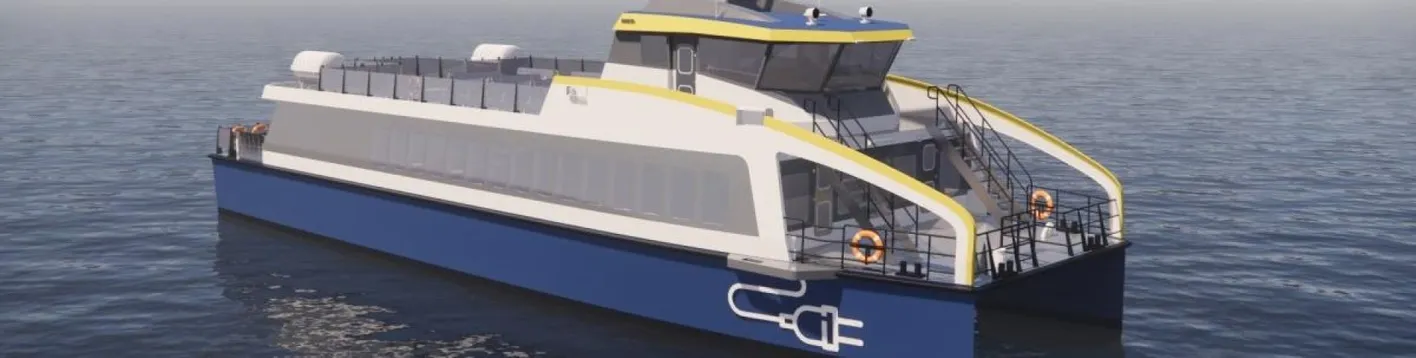
The company decided it was time for the next step; the construction of a fully electric vessel that would be able to transport 150 passengers at a time from Norddeich to the island of Norderney, quickly, cleanly and in optimal comfort.
In 150 years of operation, Reederei Norden-Frisia had never built a vessel outside of Germany. However, “Damen had the track record we were looking for. They had already built a number of fully electric vessels, some of which have already proven their reliability in operation.”
Amongst the fully electric vessels that Damen has delivered are a series of five ferries operating in the city of Copenhagen, Denmark. Additionally, the shipbuilder has been behind the construction of a fully electric harbour tug, the RSD-E Tug 2513, operating for Ports of Auckland in New Zealand.
The route that the ferry will operate required Damen to develop a completely new vessel – the Damen Fast Ferry (FFE) 3209 – known as the E-Cat Ferry.
“There are a number of factors about the route that make use of a standard vessel impossible,” says Michael. “For a start, the ferry must operate in very shallow water. In order to be able to provide a service seven times a day, the vessel's maximum draft must be no more than 1.2 metres. It’s a challenge, but Damen managed to find a solution.”
Additionally, the Wadden Sea, in which the Frisian islands are located, is a protected UNESCO World Heritage site. This imposes a number of strict criteria on vessels operating in the waters, one of which is a speed restriction.
“Obviously, one of our goals with this service was to offer people an express service to the island. However, there is a speed limit in place. A vessel operating on this route must not exceed 16 knots.”
Even with this restriction in place, the E-Cat Ferry cuts the transit time to Norderney in half – to just one hour. Charging, which takes place in just 30 minutes, can be done while passengers are embarking and disembarking.
Michael continues, “Initially, we only had the vessel in mind, but later on we saw that Damen was able to help us with the charging infrastructure and mooring solutions, just as they had with their earlier projects. With this, we currently have three projects underway, all in one place. It’s a very convenient and efficient process."
Damen's aim is not only to deliver efficient and sustainable ships to its clients, but to take on an integrator role, looking after the entire process – in this case including electrical infrastructure – often for the entire lifecycle of the vessel.
The project recently reached a significant milestone with tank testing in Duisburg. Michael says,“It was a good step forward. The model performed as expected in the tank tests and now we’re looking forward the next stages, including the keel-laying in Poland.”
Once the hull has been constructed at Damen’s yard in Kozle, it will be transported to Damen Shipyards Gorinchem for outfitting. The vessel is scheduled for delivery to Norden-Frisia in May 2024.